Say WOW

Suborbital space tourism finally arrives | FCC prepares to run public C-band auction | The big four in the U.S. launch industry — United Launch Alliance, SpaceX, Blue Origin and Northrop Grumman — hope to be one of two providers that will receive five-year contracts later this year to launch national security payloads starting in 2022. | China’s launch rate stays high | The International Space Station is the largest ever crewed object in space.

 
New 3D printing method enables complex designs...

Hearing aids, mouth guards, dental implants, and other highly tailored structures are often products of 3D printing. These structures are typically made via vat photopolymerization — a form of 3D printing that uses patterns of light to shape and solidify a resin, one layer at a time. The process also involves printing structural supports from the same material to hold the product in place as it’s printed. Once a product is fully formed, the supports are removed manually and...
Read More

At MIT, Lindsay Caplan reflects on artistic...
The intersection of art, science, and technology presents a unique, sometimes challenging, viewpoint for both scientists and artists. It is in this nexus that art historian Lindsay Caplan positions herself: “My work as an art historian focuses on the ways that artists across the 20th century engage with new technologies like computers, video, and television, not merely as new materials for making art as they already understand it, but as conceptual platforms for reorienting and reimagining the foundational assumptions...

Read More

AI stirs up the recipe for concrete...
For weeks, the whiteboard in the lab was crowded with scribbles, diagrams, and chemical formulas. A research team across the Olivetti Group and the MIT Concrete Sustainability Hub (CSHub) was working intensely on a key problem: How can we reduce the amount of cement in concrete to save on costs and emissions?  The question was certainly not new; materials like fly ash, a byproduct of coal production, and slag, a byproduct of steelmaking, have long been used to replace...

Read More

 
MIT students and postdoc explore the inner...
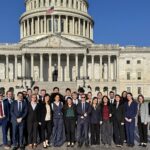
This spring, 25 MIT students and a postdoc traveled to Washington, where they met with congressional offices to advocate for federal science funding and specific, science-based policies based on insights from their research on pressing issues — including artificial intelligence, health, climate and ocean science, energy, and industrial decarbonization. Organized annually by the Science Policy Initiative (SPI), this year’s trip came at a particularly critical moment, as science agencies are facing unprecedented funding cuts. Over the course of two...

Read More

Teaching AI models the broad strokes to...
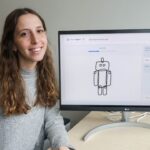
When you’re trying to communicate or understand ideas, words don’t always do the trick. Sometimes the more efficient approach is to do a simple sketch of that concept — for example, diagramming a circuit might help make sense of how the system works. But what if artificial intelligence could help us explore these visualizations? While these systems are typically proficient at creating realistic paintings and cartoonish drawings, many models fail to capture the essence of sketching: its stroke-by-stroke, iterative...

Read More

Eight with MIT ties win 2025 Hertz...
The Hertz Foundation announced that it has awarded fellowships to eight MIT affiliates. The prestigious award provides each recipient with five years of doctoral-level research funding (up to a total of $250,000), which gives them an unusual measure of independence in their graduate work to pursue groundbreaking research. The MIT-affiliated awardees are Matthew Caren ’25; April Qiu Cheng ’24; Arav Karighattam, who begins his PhD at the Institute this fall; Benjamin Lou ’25; Isabelle A. Quaye ’22, MNG ’24; Albert Qin ’24;...

Read More

 
3 Questions: How to help students recognize...
Every year, thousands of students take courses that teach them how to deploy artificial intelligence models that can help doctors diagnose disease and determine appropriate treatments. However, many of these courses omit a key element: training students to detect flaws in the training data used to develop the models. Leo Anthony Celi, a senior research scientist at MIT’s Institute for Medical Engineering and Science, a physician at Beth Israel Deaconess Medical Center, and an associate professor at Harvard Medical...

Read More

Mary Robinson urges MIT School of Architecture...
“Class of 2025, are you ready?” This was the question Hashim Sarkis, dean of the MIT School of Architecture and Planning, posed to the graduating class at the school’s Advanced Degree Ceremony at Kresge Auditorium on May 29. The response was enthusiastic applause and cheers from the 224 graduates from the departments of Architecture and Urban Studies and Planning, the Program in Media Arts and Sciences, and the Center for Real Estate. Following his welcome to an audience filled...

Read More

Chancellor Melissa Nobles’ address to MIT’s undergraduate...
Below is the text of Melissa Nobles’ remarks, as prepared for delivery today. Wow, thank you Emily and Andrew! Emily Jin on vocals and Andrew Li on saxophone, and their fellow musicians! Class of 2025! Look at you, you’re looking really good in your regalia! It’s your graduation day! You did it! Congratulations! And congratulations to all of your loved ones, all of the people who helped support you. Your parents, your brothers and sisters, your aunties and your...

Read More

 
Hank Green urges the Class of 2025...
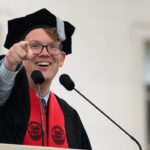
An energetic OneMIT Commencement ceremony today featured calls for MIT’s newest graduates to have a positive impact on society while upholding the Institute’s core values of open inquiry and productive innovation. “Orient yourself not just toward the construction and acquisition of new tools, but to the needs of people,” said science communicator Hank Green, in the event’s keynote remarks. He urged MIT’s newest graduates to focus their work on the “everyday solvable problems of normal people,” even if it is not...

Read More

Commencement address by Hank Green
Below is the text of Hank Green’s Commencement remarks as prepared for delivery on May 29. I don’t really do imposter syndrome, that’s where you feel like you don’t belong. I have a superior syndrome called “Hahaha I fooled them again” syndrome where I know that I don’t belong, but I also am very pleased that I have once again cleverly convinced you that I do. I, a man you might very well know as a tiktoker, a man...

Read More

MIT Corporation elects 10 term members, three...
The MIT Corporation — the Institute’s board of trustees — has elected 10 full-term members, who will serve three- or five-year terms, and three life members. Corporation Chair Mark P. Gorenberg ’76 announced the election results today. The full-term members are: Wes Bush, Ruby R. Chandy, Hala Fadel, Jacques Frederic Kerrest, Michelle K. Lee, Bianca Lepe, Natalie M. Lorenz Anderson, Sebastian S. Man, Hyun-A C. Park, and Thomas Tull. The three life members are: Orit Gadiesh, Jeff Halis, and...

Read More

 
Rationale engineering generates a compact new tool...
Scientists at the McGovern Institute for Brain Research at MIT and the Broad Institute of MIT and Harvard have re-engineered a compact RNA-guided enzyme they found in bacteria into an efficient, programmable editor of human DNA.  The protein they created, called NovaIscB, can be adapted to make precise changes to the genetic code, modulate the activity of specific genes, or carry out other editing tasks. Because its small size simplifies delivery to cells, NovaIscB’s developers say it is a...

Read More

An anomaly detection framework anyone can use
Sarah Alnegheimish’s research interests reside at the intersection of machine learning and systems engineering. Her objective: to make machine learning systems more accessible, transparent, and trustworthy. Alnegheimish is a PhD student in Principal Research Scientist Kalyan Veeramachaneni’s Data-to-AI group in MIT’s Laboratory for Information and Decision Systems (LIDS). Here, she commits most of her energy to developing Orion, an open-source, user-friendly machine learning framework and time series library that is capable of detecting anomalies without supervision in large-scale industrial...

Read More

MIT mechanical engineering course invites students to...
MIT course 2.797/2.798 (Molecular Cellular and Tissue Biomechanics) teaches students about the role that mechanics plays in biology, with a focus on biomechanics and mechanobiology: “Two words that sound similar, but are actually very different,” says Ritu Raman, the Eugene Bell Career Development Professor of Tissue Engineering in the MIT Department of Mechanical Engineering. Biomechanics, Raman explains, conveys the mechanical properties of biological materials, where mechanobiology teaches students how cells feel and respond to forces in their environment. “When students...

Read More