Say WOW

Suborbital space tourism finally arrives | FCC prepares to run public C-band auction | The big four in the U.S. launch industry — United Launch Alliance, SpaceX, Blue Origin and Northrop Grumman — hope to be one of two providers that will receive five-year contracts later this year to launch national security payloads starting in 2022. | China’s launch rate stays high | The International Space Station is the largest ever crewed object in space.

 
Understanding the war in Ukraine

MIT’s Security Studies Program (SSP) presented a special seminar on March 2 entitled, “Understanding the War in Ukraine.” Over 100 alumni and affiliates in far-flung locations tuned in to hear the seminar during a livestream presentation, which featured commentary by four experts in this realm. Participants in the discussion included two MIT professors of political science: Mariya Grinberg, whose work focuses on conflict economics, and Barry Posen, whose specialties include military doctrine and grand strategy. They were joined by...
Read More

MIT ReACT welcomes first Afghan cohort to...
Through the championing support of the faculty and leadership of the MIT Afghan Working Group convened last September by Provost Martin Schmidt and chaired by Associate Provost for International Activities Richard Lester, MIT has come together to support displaced Afghan learners and scholars in a time of crisis. The MIT Refugee Action Hub (ReACT) has opened opportunities for 25 talented Afghan learners to participate in the hub’s certificate program in computer and data science (CDS), now in its fourth...

Read More

Toward batteries that pack twice as much...
In the endless quest to pack more energy into batteries without increasing their weight or volume, one especially promising technology is the solid-state battery. In these batteries, the usual liquid electrolyte that carries charges back and forth between the electrodes is replaced with a solid electrolyte layer. Such batteries could potentially not only deliver twice as much energy for their size, they also could virtually eliminate the fire hazard associated with today’s lithium-ion batteries. But one thing has held...

Read More

 
Devavrat Shah appointed faculty director of the...
Devavrat Shah, the Andrew (1956) and Erna Viterbi Professor in the Department of Electrical Engineering and Computer Science and the Institute for Data, Systems, and Society, has been named faculty director of the MIT Deshpande Center for Technological Innovations. The new role took effect on Feb. 1. Shah replaces Tim Swager, the John D. MacArthur Professor of Chemistry, who has held the position of faculty director since 2014. Working alongside Executive Director to the Deshpande Center Leon Sandler, Swager...

Read More

MIT community stands with Ukraine at candlelight...
People from across MIT gathered outside the Student Center on March 3 for a candlelight rally to support MIT’s Ukrainian community and condemn attacks on Ukraine by Russian forces. “It was great to see so many people that I’ve never met before come together,” said Ukrainian third-year student Mariia Smyk. “It was such a powerful experience.” Students shared personal stories of loved ones in Ukraine who are evacuating to neighboring countries, sheltering from attacks, or joining resistance efforts. Others...

Read More

MIT Center for Real Estate launches the...
To appreciate the explosive urbanization taking place in Asia, consider this analogy: Every 40 days, a city the equivalent size of Boston is built in Asia. Of the $24.7 trillion real estate investment opportunities predicted by 2030 in emerging cities, $17.8 trillion (72 percent) will be in Asia. While this growth is exciting to the real estate industry, it brings with it the attendant social and environmental issues. To promote a sustainable and innovative approach to this growth, leadership...

Read More

 
Objection: No one can understand what you’re...
Legal documents, such as contracts or deeds, are notoriously difficult for nonlawyers to understand. A new study from MIT cognitive scientists has determined just why these documents are often so impenetrable. After analyzing thousands of legal contracts and comparing them to other types of texts, the researchers found that lawyers have a habit of frequently inserting long definitions in the middle of sentences. Linguists have previously demonstrated that this type of structure, known as “center-embedding,” makes text much more...

Read More

New maps show airplane contrails over the...
As Covid-19’s initial wave crested around the world, travel restrictions and a drop in passengers led to a record number of grounded flights in 2020. The air travel reduction cleared the skies of not just jets but also the fluffy white contrails they produce high in the atmosphere. MIT engineers have mapped the contrails that were generated over the United States in 2020, and compared the results to prepandemic years. They found that on any given day in 2018,...

Read More

Q&A: Climate Grand Challenges finalists on building...
Note: This is the first in a four-part interview series that will highlight the work of the Climate Grand Challenges finalists, ahead of the April announcement of several multiyear, flagship projects. The finalists in MIT’s first-ever Climate Grand Challenges competition each received $100,000 to develop bold, interdisciplinary research and innovation plans designed to attack some of the world’s most difficult and unresolved climate problems. The 27 teams are addressing four Grand Challenge problem areas: building equity and fairness into climate...

Read More

 
MIT engineering design and rapid prototyping course...
The Bernard M. Gordon-MIT Engineering Leadership Program (GEL Program) recently revamped and relaunched 16.810 (Engineering Design and Rapid Prototyping), an existing Department of Aeronautics and Astronautics course last taught in 2012 that was updated to center on a new multidisciplinary project focused on the fundamental skills in engineering design. D-PRO serves as one of five elective course offerings students in the GEL 1 Program can choose from in order to fulfill the Design and Innovation Leadership Requirement. The course...

Read More

Unlocking new doors to artificial intelligence
Artificial intelligence research is constantly developing new hypotheses that have the potential to benefit society and industry; however, sometimes these benefits are not fully realized due to a lack of engineering tools. To help bridge this gap, graduate students in the MIT Department of Electrical Engineering and Computer Science’s 6-A Master of Engineering (MEng) Thesis Program work with some of the most innovative companies in the world and collaborate on cutting-edge projects, while contributing to and completing their MEng...

Read More

Leveraging schools for political influence
“When I began graduate school, the issue of states losing control over their central functions piqued my interest,” says Blair Read, a sixth-year doctoral candidate in political science. To tackle such a broad agenda, she zeroed in on the case of private schooling. “It has exploded worldwide, especially in lower- and middle-income countries, and I’m trying to explain the phenomenon — the politics behind what is happening and how it might change the political landscape,” she says. With survey...

Read More

 
Launchpad for health care entrepreneurs
When computation and systems biology PhD student Elvira Kinzina was diagnosed with Lyme disease during her first year at MIT, she struggled to find a doctor specializing in the disease — even though Boston is renowned for its thriving health care community. She soon found out this was common for Lyme patients, with many specialists booked out months, years, or indefinitely. Now, she is involved with a new Independent Activities Period (IAP) program focused on health care entrepreneurship, and...

Read More

Gina Raimondo: “Let’s get back to the...
The global semiconductor shortage, a major driver of ballooning U.S. inflation, is as much a national security issue as an economic issue, U.S. Secretary of Commerce Gina Raimondo said during a recent visit to MIT. Speaking at MIT.nano, a shared 214,000-square-foot research center for nanoscale science and engineering located in the heart of campus, Raimondo said that not long ago, the U.S. produced about 40 percent of the world’s semiconductors. Today, the nation makes only about 12 percent. By...

Read More

Training STEM teachers to uncover students’ full...
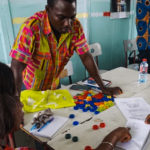
In the summer of 2011, MIT PhD student Heather Beem travelled to a rural region of Ghana to try engaging students from low-resource schools in hands-on learning projects. She began by asking a group of high school students what they wanted to work on. “They said, ‘Anything, whatever you want,’” Beem recalls. Hoping to narrow things down a bit, she asked what kinds of materials they had to work with. “As soon as I mentioned materials, the atmosphere in...

Read More